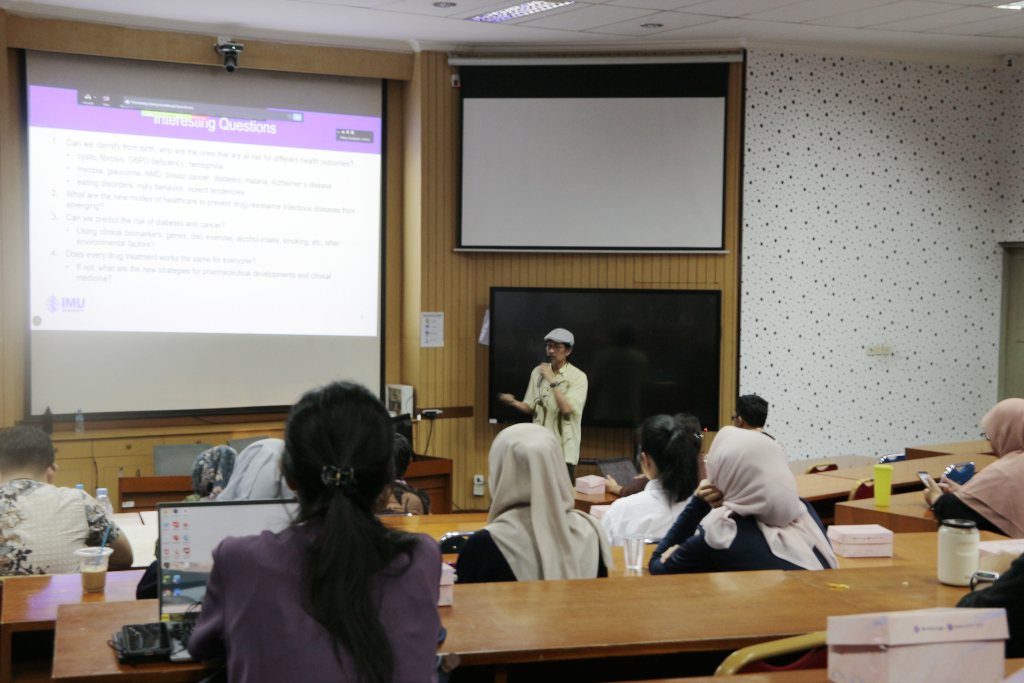
FK-KMK UGM. Three decades ago, confirming the emergence of a single new virus took months. When COVID-19 struck, the same confirmation arrived in under two months, and later narrowed to a matter of days for each new variant. That leap framed Prof. Hoh Boon-Peng’s Visiting Professor Guest Lecture, “Opportunities and Challenges of Public Health in Post-Genomics Era”, held on Thursday (12/11) at the Third Floor Lecture Room of Bambang Soetarso Building, FK-KMK UGM, and online via Zoom Meeting.
The lecture was organised by the Paediatric Surgery Study Program together with the Master’s Program in Clinical Medicine and the Genetics Working Group of FK-KMK UGM, with Dr. Dhite Bayu Nugroho moderating. The professor from International Medical University, Malaysia, opened with genomic surveillance. Antibiotic, antiretroviral, and antimalarial resistance keeps recurring because pathogens “evolve much faster” than humans can design drugs or vaccines. Without surveillance, he noted, health systems merely chase resistance that has already spread.
Turning to prevention, he presented a polygenic risk model for type 2 diabetes. Clinical biomarkers such as HbA1c often shift only when the disease is nearly established, leaving little room for lifestyle intervention. Genetic information combined with clinical factors, by contrast, improves both the sensitivity and specificity of prediction and even helps anticipate complications.
The opportunity closest to daily practice, he continued, lies in pharmacogenomics. Effective warfarin doses differ across ethnic groups in Malaysia, while the HLA-B5701 mutation has made genetic testing mandatory before abacavir is prescribed in the United States. The HLA-B1502 variant linked to carbamazepine is likewise found in roughly 15 percent of individuals of Southeast Asian ancestry.
Even so, Prof. Hoh acknowledged that most academic institutions remain at the clinical discovery stage. Moving further demands local validation, health technology assessment, accredited laboratories, a genetic counselling framework, workforce education, and regulations that address subsidies, data ownership, and insurance coverage.
The discussion session deepened the question of representation. Responding to the moderator, he explained that 96 percent of genomic reference panels come from European and East Asian populations, leaving predictions for Southeast Asia prone to inaccuracy. He offered two ways forward, namely regional collaboration to build a shared reference panel or the use of multi-ancestry variants. A following question examined pre-treatment genetic testing for colorectal cancer, which in Malaysia is also not mandated and still rests on oncologists’ recommendations.
Through this forum, FK-KMK UGM affirms its contribution to SDGs point 3 (good health and well-being), point 4 (quality education), and point 17 (partnerships for the goals). (Reporter: Balanca Qolta)