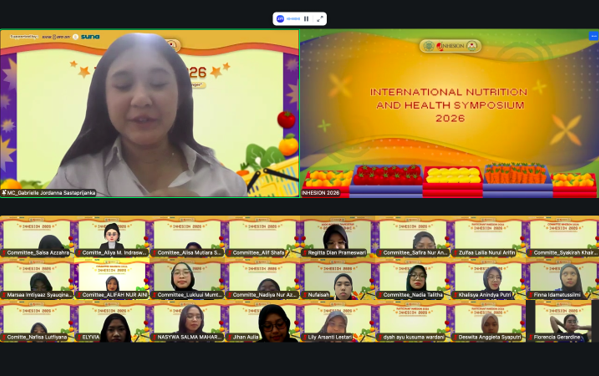
FK-KMK UGM. Feeling full does not necessarily mean the body is well nourished. A person may eat enough food yet still lack essential vitamins and minerals. This condition, known as hidden hunger, was the focus of the International Nutrition and Health Symposium (INHESION) 2026.
Themed “Nutrition and Food Innovations to End Hidden Hunger”, the symposium was organized by the Health Nutrition Student Association (HIMAGIKA) and the Department of Health Nutrition, FK-KMK UGM, and was held online via Zoom Meeting on Sunday (8/11). Head of the Department of Health Nutrition, FK-KMK UGM, Prof. Dr. Lily Arsanti Lestari, STP, MP., emphasized that the problem affects not only those who lack access to food, but also millions of others. “This event explores how to end hidden hunger through nutrition and food innovation, while building a healthier future for everyone,” she said.
To examine the issue, the symposium featured three speakers: Prof. Dr. Siti Helmyati, DCN, M.Kes. from Universitas Gadjah Mada, Prof. Leila S. Africa, RND, Ph.D. from the University of the Philippines Los Baños, and Yuga Putri Pramesti, S.Gz., M.Sc., founder of Seribu Project. Together, they offered complementary perspectives, ranging from evidence-based nutrition interventions and strengthening program management and evaluation to local food diversification through the “Isi Piringku” (Fill My Plate) approach.
In the first session, Prof. Siti Helmyati noted that in 2024, 150.2 million children under five worldwide were stunted, while another 42.8 million experienced wasting. She stressed that interventions must be matched to the problem and the target population. An improvement in anemia, for instance, does not automatically translate into better child growth. Likewise, a program that succeeds in research settings may not deliver the same results when implemented through routine services.
She also highlighted a paradigm shift from treating stunting to preventing it. Prevention efforts are no longer limited to the First 1,000 Days of Life, but have been expanded to the First 8,000 Days, starting from adolescence. At this stage, anemia education for adolescent girls still faces challenges, including the misconception that iron supplements can bring on menstruation earlier.
Furthermore, Prof. Helmyati encouraged participants to return to the most fundamental step: practicing balanced nutrition in daily life. “We often talk about distant matters, yet overlook what is close to us. Do our diets and those of the people around us meet the principles of balanced nutrition?” she remarked. Nevertheless, she reminded that this practice also depends on the food system’s ability to provide access for the public. “We are at the downstream end of nutrition problems, while the upstream is long,” she added.
Through INHESION 2026, FK-KMK UGM contributes to the Sustainable Development Goals (SDGs), particularly Goal 2 (Zero Hunger) through efforts to end hidden hunger, Goal 3 (Good Health and Well-being) through stronger nutrition interventions for vulnerable groups, and Goal 17 (Partnerships for the Goals) through cross-country academic collaboration. (Reporter: Balanca Qolta).