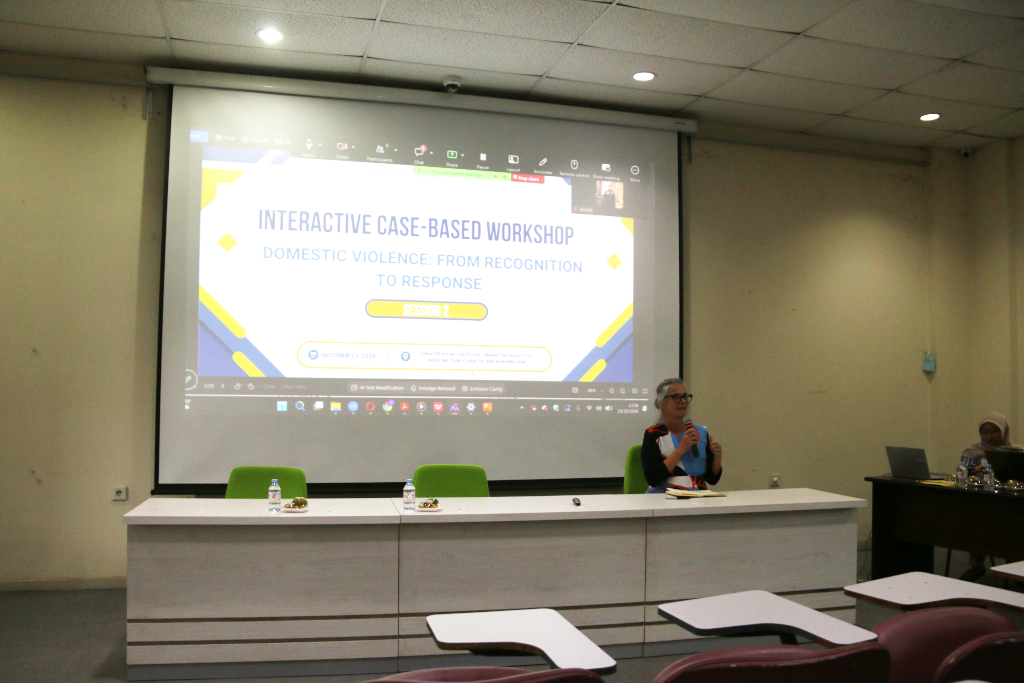
FK-KMK UGM. Not every wound shows on the surface of the skin. In many cases of domestic violence, what reaches the examination room is only an everyday complaint, such as persistent headaches, constant fatigue, and sleep that is no longer restful. That awareness underpinned the Interactive Case-Based Workshop “Domestic Violence: From Recognition to Response,” organized by the Department of Family and Community Medicine together with the Department of Forensic and Medicolegal and the Department of Psychiatry of FK-KMK UGM, in collaboration with The University of Melbourne, Australia. The event was held in person on Friday (23/10/2026) at the Theater Room, 2nd Floor, UGM Library FK-KMK UGM.
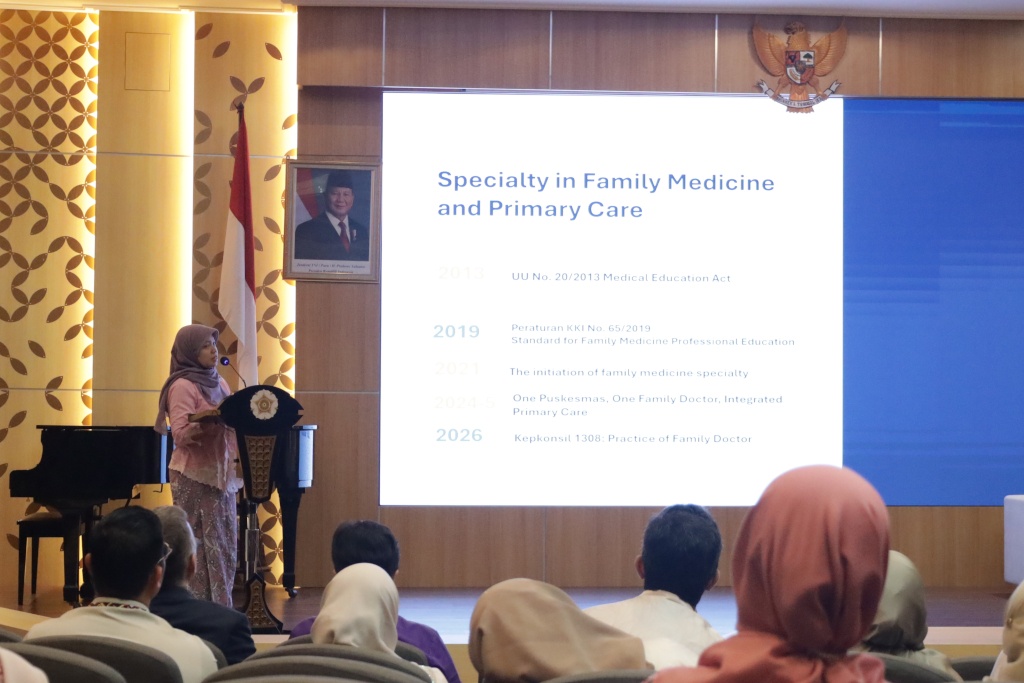
Two speakers broadened the participants’ insights: Prof. Kelsey Heggarty, MBBS, PhD, FRACGP from The University of Melbourne and dr. Beta Ahlam, DFM, Sp.FM Subsp. FK(K) from UGM. The discussions were guided by facilitators dr. Idha Arfianti Wiraagni, M.Sc., Sp.F.M., Subsp.P.F.(K), Ph.D., dr. Fitriana Murriya, MPHC, Sp.KKLP, Ph.D., Subsp.FOMC, and Dr. dr. Andrian Fajar, M.Sc., Sp.KJ(K).
In her presentation, dr. Beta emphasized that addressing violence requires an integrated legal approach. Law No. 23 of 2004 regulates four forms of domestic violence, namely physical, psychological, sexual, and neglect, while Law No. 12 of 2022 strengthens evidentiary rules and victims’ rights to services, protection, and recovery. She also highlighted the recognition of marital rape in the new Indonesian Criminal Code. For health professionals, this body of law translates into four roles: assessing and treating, documenting, supporting evidence, and referring and following up. Clinical records serve as evidence, while the assessment of legal sufficiency remains the court’s authority.
Prof. Kelsey complemented this perspective with Australia’s experience. According to her, the laws in both countries are very similar, yet only a small proportion of survivors eventually reach the courtroom. “It’s not just a justice response,” she said. She also reminded participants of the limits of a doctor’s role. “We’re not trying to gather evidence to prove anything. We are doctors, and we record what was said and what we found as best we can, because we don’t know when it might be needed,” she explained. She even considered Indonesia ahead in regulating psychological violence and coercive control.
This understanding was then put to the test through a case-based workshop. Participants examined the case of Ayu, a 38-year-old woman who had complained of headaches and fatigue for over a year despite normal examination results, and formulated questions to explore her situation at home. Through the discussion, participants practiced the sequence of recognizing, assessing, documenting, coordinating, and following up.
The event is in line with the Sustainable Development Goals (SDGs), particularly Goal 3 on Good Health and Well-being, Goal 5 on Gender Equality, Goal 16 on Peace, Justice and Strong Institutions, and Goal 17 on Partnerships for the Goals. Through interdisciplinary and cross-border collaboration, FK-KMK UGM hopes health professionals will be better prepared to support survivors holistically. (Reporter: Balanca Qolta).