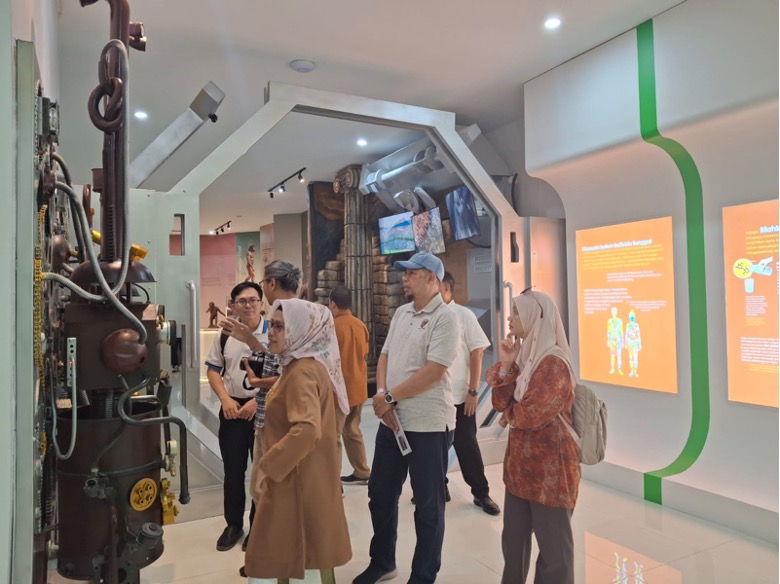
Museum and Laboratory of Bio-Paleoanthropology, Faculty of Medicine, Public Health, and Nursing (FK-KMK), Gadjah Mada University, received an award for its contribution to the international exhibition of “Indonesia, The Oldest Civilization on Earth? 130 Years After Pithecannthropus Erectus”, which held at the National Museum of Indonesia in Jakarta from December 20, 2024, to April 20, 2025.
This award was given as a symbol of appreciation for the active participation of the Museum and Laboratory of Bio-Paleoanthropology FK-KMK UGM in enriching the exhibition by presenting rare and valuable fossil collections, including important artifacts from historical sites such as Sangiran and Trinil. One of the main collections on display is the tibia (shin bone) of Homo erectus Ngandong, which has become a unique attraction in this exhibition.
This exhibition was held to commemorate the 130th anniversary of the discovery of the Pithecanthropus erectus fossil by Eugene Dubois in Trinil, East Java, in 1894. With an educational and reflective tone, the exhibition featured more than 20 special collections from various national institutions. One of its main highlights was the Homo erectus S-17 skull, the most complete ancient human skull ever displayed to the public, offering visitors a glimpse into the long evolutionary journey of humanity in the Nusantara region.
More than just a tribute to the history of science, this exhibition also served as a public education forum that emphasizes Indonesia’s important role in the history of human evolution. Public enthusiasm had been hight, with more than 12,000 visitors attending the exhibition during its four-month run, demonstrating the public’s keen interest in ancient history and the nation’s cultural heritage.
The contribution of the Museum and Laboratory of Bio-Paleoanthropology FK-KMK UGM to this exhibition aligns with the Sustainable Development Goals (SDGs), particularly point 4: Quality Education, which promotes access to quality education and historical literacy for all; Point 11: Sustainable Cities and Communities; and Point 17: Partnership for the Goals.
This award is significant for the Museum and Laboratory of Bio-Paleoanthropology at the Faculty of Medicine and Public Health, Universitas Gadjah Mada, as a center of reference for education and research in the fields of paleontology, archaeology, and anthropology. It is hoped that this achievement will inspire the younger generation to learn more about, love, and explore their nation’s history, as well as open up broader opportunities for collaboration at both the national and international levels. (Contributor: Ilham Novitasari, Translator: Tedy A)